Uranus (Planet)
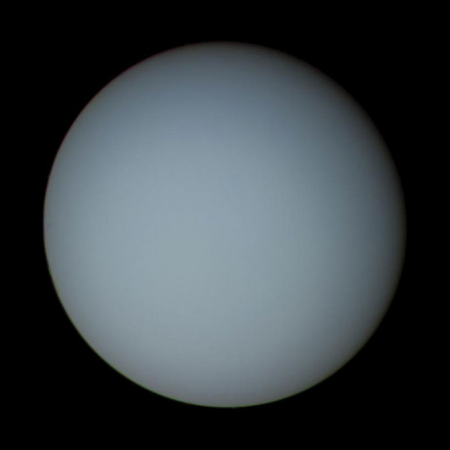
© NASA/Voyager 2
Finder chart


Click and drag the chart above to pan around the sky, or use the mouse wheel to zoom.
Click to enlarge.
From South El Monte , Uranus is visible in the dawn sky, rising at 00:37 (PDT) and reaching an altitude of 53° above the eastern horizon before fading from view as dawn breaks at around 05:04.
Begin typing the name of a town near to you, and then select the town from the list of options
which appear below.
|
Name
Uranus
|
Object type
Superior planet
|
Current position
| Computed for: | 12 August 2026 |
| Right ascension: | 04h12m [2] |
| Declination: | +20°58' [2] |
| Constellation: | Taurus |
| Magnitude: | 5.74 (V) [1] |
| Angular diameter: | 3.6 arcsec[2] |
| Distance: | 19.70 AU 163.84 lightmin [2] |
Orbital elements [2]
| Semi-major axis: | 19.19 AU |
| Eccentricity: | 0.047257 |
| Inclination: | 0.77° |
| Longitude ascending node: | 74.02° |
| Argument of perihelion: | 96.94° |
| Epoch of elements: | 1 Jan 2000 |
| Mean Anomaly at epoch: | 142.28° |
| Absolute mag (H): | -7.17 [1] |
| Slope parameter (n): | 2.00 [1] |
Derived quantities
| Perihelion: | 18.28 AU |
| Aphelion: | 20.10 AU |
| Orbital period: | 84.06 years |
Sources
| [1] | Robin M. Green, Spherical Astronomy, 1985, ISBN 0-521-31779-7 |
| [2] | Explanatory Supplement to the Astronomical Almanac, 2013, Urban & Seidelmann, Eds., Table 8.7, ISBN 978-1-891389-85-6 |
Visibility from South El Monte
All times shown in South El Monte local time.
Events
| 10 Sep 2026 | – Uranus enters retrograde motion |
| 25 Nov 2026 | – Uranus at opposition |
| 08 Feb 2027 | – Uranus ends retrograde motion |
| 26 May 2027 | – Uranus at solar conjunction |
| 15 Sep 2027 | – Uranus enters retrograde motion |
| 30 Nov 2027 | – Uranus at opposition |
| 12 Feb 2028 | – Uranus ends retrograde motion |
| 30 May 2028 | – Uranus at solar conjunction |
Printable finder charts
