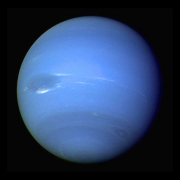



Neptune's 164.9-year orbit around the Sun will carry it to its furthest point to the Sun – its aphelion – at a distance of 30.34 AU.
In practice, however, Neptune's orbit is very close to circular; its distance from the Sun only varies by about 1.7% between perihelion and aphelion. This means that the difference in the amount of heat and light it receives from the Sun between aphelion and perihelion is extremely small.
Finding Neptune
Neptune's distance from the Sun doesn't affect its appearance. From South El Monte, at the moment of aphelion it will be visible in the dawn sky, rising at 03:19 (PDT) – 3 hours and 23 minutes before the Sun – and reaching an altitude of 24° above the south-eastern horizon before fading from view as dawn breaks at around 05:38.
A chart of the path of Neptune across the sky in 2125 can be found here, and a chart of its rising and setting times here.
The position of Neptune at the moment it passes aphelion will be:
| Object | Right Ascension | Declination | Constellation | Magnitude | Angular Size |
| Neptune | 14h37m50s | 13°35'S | Libra | 8.0 | 2.2" |
The coordinates above are given in J2000.0.
The sky on 7 Jul 2026
| The sky on 7 July 2026 | ||||||||||||||||||||||||||||||||||
|
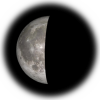
38% 23 days old |
All times shown in PDT.
|
|||||||||||||||||||||||||||||||||
Source
The circumstances of this event were computed using the DE440 planetary ephemeris published by the Jet Propulsion Laboratory (JPL).
This event was automatically generated by searching the ephemeris for planetary alignments which are of interest to amateur astronomers, and the text above was generated based on an estimate of your location.
Related news
| 20 Jul 2125 | – Neptune ends retrograde motion |
| 13 Feb 2126 | – Neptune enters retrograde motion |
| 02 May 2126 | – Neptune at opposition |
| 23 Jul 2126 | – Neptune ends retrograde motion |
Image credit
© NASA/Voyager 2