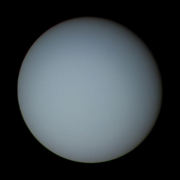




Uranus will pass close to the Sun in the sky as its orbit carries it around the far side of the solar system from the Earth.
At closest approach, Uranus will appear at a separation of only 0°16' from the Sun, making it totally unobservable for several weeks while it is lost in the Sun's glare.
At around the same time, Uranus will also be at its most distant from the Earth – receding to a distance of 19.71 AU – since the two planets will lie on opposite sides of the solar system.
Over following weeks and months, Uranus will re-emerge to the west of the Sun, gradually becoming visible for ever-longer periods in the pre-dawn sky. After around six months, it will reach opposition, when it will be visible for virtually the whole night. A chart of the path of Uranus across the sky in 1979 can be found here, and a chart of its rising and setting times here.
The position of Uranus at the moment it passes solar conjunction will be:
| Object | Right Ascension | Declination | Constellation | Angular Size |
| Uranus | 15h16m50s | 17°53'S | Libra | 3.6" |
| Sun | 15h16m | 18°09'S | Libra | 32'19" |
The coordinates above are given in J2000.0.
The sky on 22 Aug 2026
| The sky on 22 August 2026 | ||||||||||||||||||||||||||||||||||
|
74% 10 days old |
All times shown in PDT.
|
|||||||||||||||||||||||||||||||||
Warning
Never attempt to point a pair of binoculars or a telescope at an object close to the Sun. Doing so may result in immediate and permanent blindness.
Source
The circumstances of this event were computed using the DE440 planetary ephemeris published by the Jet Propulsion Laboratory (JPL).
This event was automatically generated by searching the ephemeris for planetary alignments which are of interest to amateur astronomers, and the text above was generated based on an estimate of your location.
Related news
| 26 Jul 1979 | – Uranus ends retrograde motion |
| 28 Feb 1980 | – Uranus enters retrograde motion |
| 13 May 1980 | – Uranus at opposition |
| 30 Jul 1980 | – Uranus ends retrograde motion |
Image credit
© NASA/Voyager 2