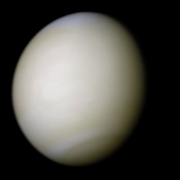




Venus's 225-day orbit around the Sun will carry it to its furthest point to the Sun – its aphelion – at a distance of 0.73 AU.
In practice, however, Venus's orbit is very close to circular; its distance from the Sun varies by only about 1.5% between perihelion and aphelion. This makes Venus's orbit more perfectly circular than that of any of the Solar System's other planets. As a result, its surface receives almost exactly the same amount of energy from the Sun at perihelion (closest approach to the Sun) and aphelion (furthest recess from the Sun).
The position of Venus at the moment it passes aphelion will be:
| Object | Right Ascension | Declination | Constellation | Angular Size |
| Venus | 19h20m10s | 23°24'S | Sagittarius | 10.3" |
| Sun | 18h08m | 23°25'S | Sagittarius | 32'31" |
The coordinates above are given in J2000.0.
From South El Monte, Venus will be difficult to observe as it will appear no higher than 8° above the horizon. It will become visible at around 17:03 (PDT), 8° above your south-western horizon, as dusk fades to darkness. It will then sink towards the horizon, setting 1 hour and 11 minutes after the Sun at 17:57.
The sky on 23 Jun 2026
| The sky on 23 June 2026 | ||||||||||||||||||||||||||||||||||
|
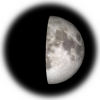
68% 8 days old |
All times shown in PDT.
|
|||||||||||||||||||||||||||||||||
Warning
Never attempt to point a pair of binoculars or a telescope at an object close to the Sun. Doing so may result in immediate and permanent blindness.
Source
The circumstances of this event were computed using the DE440 planetary ephemeris published by the Jet Propulsion Laboratory (JPL).
This event was automatically generated by searching the ephemeris for planetary alignments which are of interest to amateur astronomers, and the text above was generated based on an estimate of your location.
Related news
| 15 Mar 2038 | – Venus at greatest elongation west |
| 09 May 2039 | – Venus at highest altitude in evening sky |
| 30 May 2039 | – Venus at greatest elongation east |
| 18 Oct 2039 | – Venus at highest altitude in morning sky |
Image credit
© NASA/Ricardo Nunes