



Venus and Uranus will share the same right ascension, with Venus passing 29' to the south of Uranus.
From South El Monte however, the pair will not be readily observable since they will be very close to the Sun, at a separation of only 13° from it.
Venus will be at mag -3.9, and Uranus at mag 5.8, both in the constellation Ophiuchus.
The pair will be close enough to fit within the field of view of a telescope, but will also be visible through a pair of binoculars.
A graph of the angular separation between Venus and Uranus around the time of closest approach is available here.
The positions of the two objects at the moment of conjunction will be as follows:
| Object | Right Ascension | Declination | Constellation | Magnitude | Angular Size |
| Venus | 17h24m30s | 23°47'S | Ophiuchus | -3.9 | 10"1 |
| Uranus | 17h24m30s | 23°17'S | Ophiuchus | 5.8 | 3"5 |
The coordinates above are given in J2000.0. The pair will be at an angular separation of 13° from the Sun, which is in Ophiuchus at this time of year.
The sky on 6 Aug 2026
| The sky on 6 August 2026 | ||||||||||||||||||||||||||||||||||
|
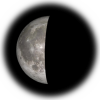
37% 23 days old |
All times shown in PDT.
|
|||||||||||||||||||||||||||||||||
Warning
Never attempt to point a pair of binoculars or a telescope at an object close to the Sun. Doing so may result in immediate and permanent blindness.
Source
The circumstances of this event were computed using the DE440 planetary ephemeris published by the Jet Propulsion Laboratory (JPL).
This event was automatically generated by searching the ephemeris for planetary alignments which are of interest to amateur astronomers, and the text above was generated based on an estimate of your location.
Related news
| 28 Aug 2070 | – Uranus ends retrograde motion |
| 01 Apr 2071 | – Uranus enters retrograde motion |
| 16 Jun 2071 | – Uranus at opposition |
| 01 Sep 2071 | – Uranus ends retrograde motion |
Image credit
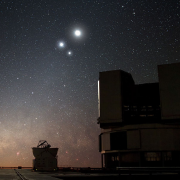
The Moon in conjunction with Venus and Jupiter, with the Very Large Telescope in the foreground. Image © Y. Beletsky, ESO, 2009.