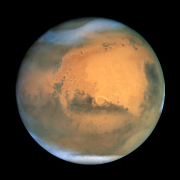



Mars's orbit around the Sun will carry it to its closest point to the Earth – its perigee – passing within 0.43 AU of us.
The days around perigee represent the best time to observe Mars, since both its size and brightness in the night sky increase when it is close to us.
This effect is especially dramatic for Mars since it neighbours the Earth in the Solar System, orbiting a little further out from the Sun than us, at an average distance of 1.52 AU. As a result, it has the greatest variation of all the planets in its distance from the Earth, depending on whether the two planets are on opposite sides of the Sun, or passing next to one another in their respective orbits.
Mars reaches perigee at around the time when it passes the Earth in its orbit. At this time, the Sun, Earth and Mars lie in a straight line, with the Earth in the middle.
Consequently, Mars appears almost exactly opposite the Sun in the sky – a configuration called opposition, when Mars reaches its highest point in the sky at midnight and is visible for much of the night.
Every perigee of Mars is associated with a near-simultaneous opposition, but the two events typically occur a few days apart owing to the significant ellipticity of Mars's orbit.
On this occasion, Mars will attain a maximum angular diameter of 21.9 arcsec at closest approach, and a maximum brightness of magnitude -2.5 .
Observing Mars
Even at its closest approach to the Earth, it is never possible to distinguish Mars as more than a star-like point of light with the naked eye, though a simple pair of binoculars is sufficient to reveal it as a disk of light.
From South El Monte , it will be visible in the evening sky, becoming accessible around 20:28 (PDT), 8° above your south-eastern horizon, as dusk fades to darkness. It will then reach its highest point in the sky at 00:17, 27° above your southern horizon. It will continue to be observable until around 04:03, when it sinks below 7° above your south-western horizon.
A chart of the path of Mars across the sky in 1954 can be found here, and a chart of its rising and setting times here.
The table below lists Mars' angular size and brightness at two-week intervals throughout its apparition:
| Date | Right ascension | Declination | Angular size | Magnitude |
| 15 Apr 1954 | 18h07m30s | 23°45'S | 11.4” | -0.4 |
| 29 Apr 1954 | 18h26m10s | 24°10'S | 13.2” | -0.8 |
| 13 May 1954 | 18h37m40s | 24°43'S | 15.4” | -1.3 |
| 27 May 1954 | 18h40m00s | 25°33'S | 17.9” | -1.7 |
| 10 Jun 1954 | 18h31m40s | 26°38'S | 20.2” | -2.2 |
| 24 Jun 1954 | 18h14m40s | 27°40'S | 21.7” | -2.5 |
| 08 Jul 1954 | 17h56m00s | 28°16'S | 21.7” | -2.4 |
| 22 Jul 1954 | 17h44m20s | 28°22'S | 20.5” | -2.1 |
| 05 Aug 1954 | 17h44m20s | 28°13'S | 18.6” | -1.8 |
| 19 Aug 1954 | 17h56m20s | 27°55'S | 16.6” | -1.4 |
| 02 Sep 1954 | 18h17m40s | 27°26'S | 14.8” | -1.1 |
As Mars passes perigee, its position will be:
| Object | Right Ascension | Declination | Constellation | Magnitude | Angular Size |
| Mars | 18h04m10s | 28°03'S | Sagittarius | -2.5 | 21.9" |
The coordinates above are given in J2000.0.
The sky on 1 Aug 2026
| The sky on 1 August 2026 | ||||||||||||||||||||||||||||||||||
|
90% 18 days old |
All times shown in PDT.
|
|||||||||||||||||||||||||||||||||
Source
The circumstances of this event were computed using the DE440 planetary ephemeris published by the Jet Propulsion Laboratory (JPL).
This event was automatically generated by searching the ephemeris for planetary alignments which are of interest to amateur astronomers, and the text above was generated based on an estimate of your location.
Related news
| 02 Jul 1954 | – Mars at perigee |
| 29 Jul 1954 | – Mars ends retrograde motion |
| 10 Aug 1956 | – Mars enters retrograde motion |
| 06 Sep 1956 | – Mars at perigee |
Image credit
© NASA/Hubble Space Telescope